Guggi At Tribeca—By PJ
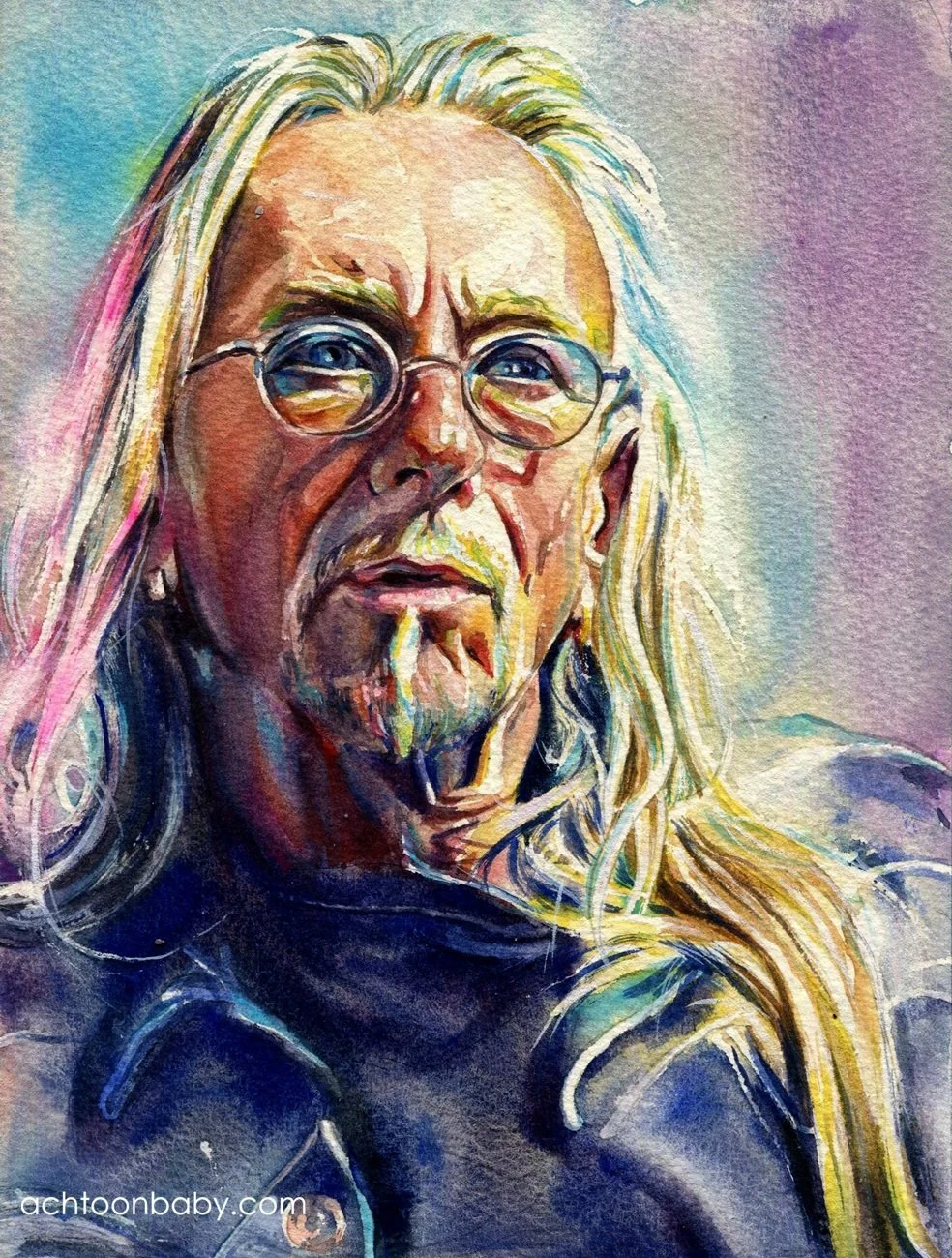
Guggi, watercolor by Kelly Eddington, 2026. Based on a still from the movie.
Guggi at the Tribeca Film Festival
Or, That Time I Went to the Movies with Bono
PJ DeGenaro
Whether you watch Guggi as a modern art connoisseur or just out of curiosity, you’ll be left with the idea that one small, unpretentious man can contain an entire world, with its own language, symbols, and mythology. And you might come away wondering about the shapes and symbols of your own world.
Many of us came to know Guggi (Derek Rowen) through his association with U2, the Virgin Prunes, and as a member of Lypton Village, but he has a compelling story of his own.
Unfortunately, the New York premier of Guggi was overshadowed somewhat by Bono’s presence. Not sure what to expect, I got to the SVA Theater on 23rd Street early. The theater is an artsy multiplex, and other films were being screened the same evening. I was first in line for Guggi, and by the time we were let in, I was hot and tired. I plunked myself into the front row. When Bono and Ali arrived, they were led to reserved seats, two rows behind me. But I stayed where I was because I am mature and unbothered. And that is how I came to be at the movies with Bono.
But let’s stick with Guggi: The film is directed and photographed beautifully by Ian Thuillier, another Dubliner who has also made documentaries about Gavin Friday and Rory Gallagher. Interview segments take place in various indoor and outdoor spots, in Dublin and beyond. Between the interviews, we see Guggi working in his home studio: painting, stretching canvases, and even crawling on the floor to cut out the arcs that will eventually come together to form one of his famous bowls. His narration during these scenes is always low-key and personable. He did not attend art school. This is his work, he figured it out for himself, and he enjoys it.
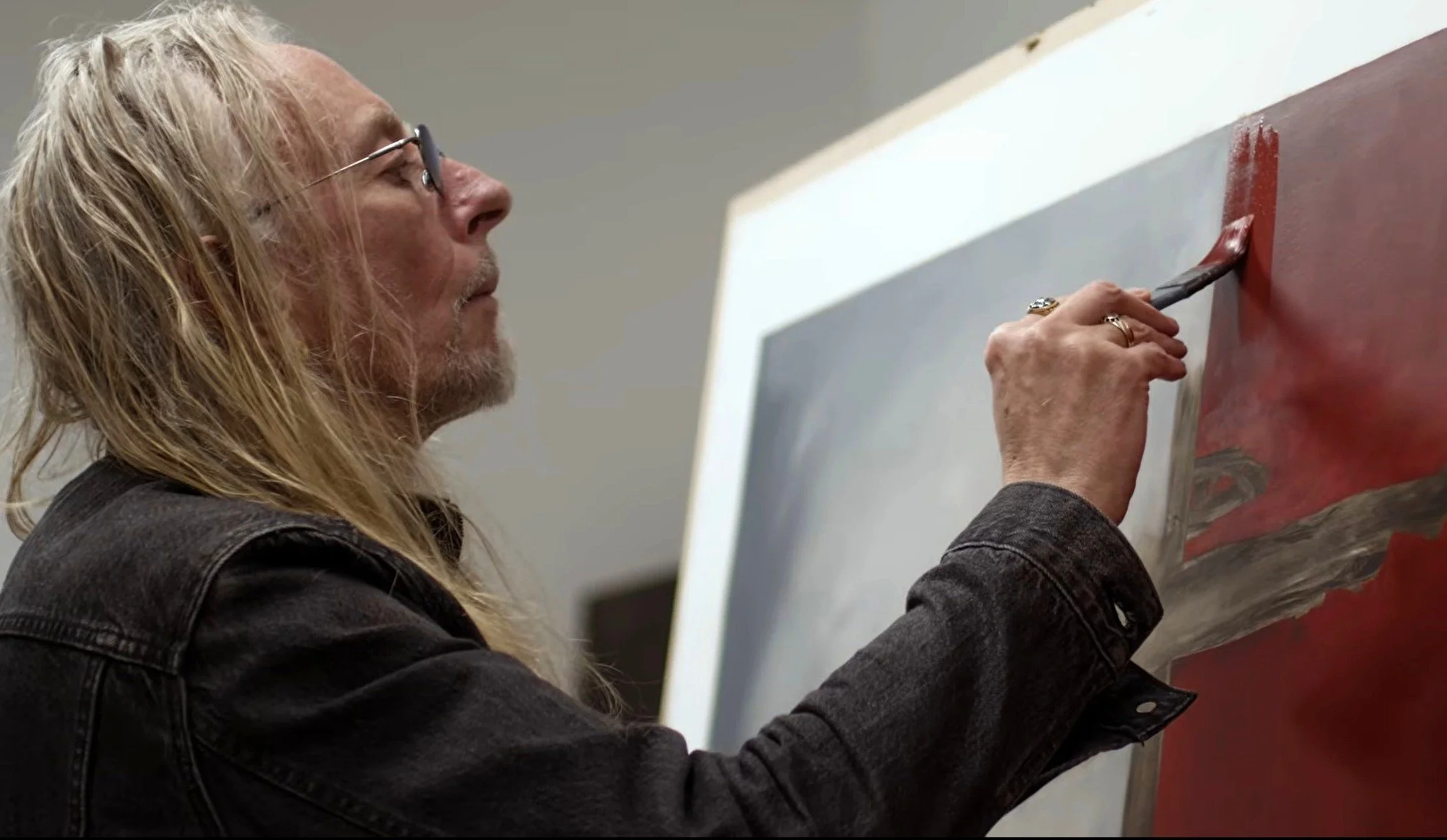
Guggi painting in this still from the documentary.
Contemporary scenes are interspersed with archival footage of Dublin — from the time it was bombed unexpectedly by Germany during World War II, up to the somewhat grim, repressive 1970s and 80s. The city is almost another character in the film, and it is a tough one. It seems there was never enough for everyone, in spite of how hard they worked. Sometimes there wasn’t enough work. But there were and still are lots of churches.
The church loomed large in Guggi’s childhood. His family was Protestant, which is unusual in Dublin, and Guggi and his siblings spent the best part of every Sunday in church, including two full services and what we in the U.S. call youth groups in the afternoons and evenings. And Guggi is still a man of faith, in his own way.
We’ve heard Bono talk about Irish fathers who crush their children’s dreams in order to keep them from getting hurt. Mr. Rowen, with his brood of towheaded sons and daughters, comes across as a bit of a brute. Guggi doesn’t dwell on it, but I will not soon forget his description of his father dragging a metal comb across his sons’ scalps every morning. It’s no wonder that as adults they all seem to prefer unconventional hairstyles.
Then there is the Cornflake Bowl and the Unsettling Water Pitcher: Cornflakes were a staple breakfast product in the Rowen household, and Guggi had his own bowl — a bowl that seems to hold nourishment and fraught memories in equal measure. The pitcher belonged to Guggi’s grandmother and he found the shape of it to be sinister. Bowls and pitchers would go on to figure prominently in his paintings.
Guggi stops short of making a direct connection between his difficult upbringing and the stillness of his art, but it’s implicit. He seems to have been pursuing a calm, solitary place throughout his young adulthood, and in fact he ultimately quit the Virgin Prunes to keep pursuing it.
Mr. Thuillier interviewed Guggi and his other subjects over several years in various settings. Solo chats with Bono and Gavin take place indoors, with muted colors and somber lighting that made this old art student think of Rembrandt. Elsewhere, the three Lypton Village guys hang out together, painting on top of each other’s portraits, and giving each other hell. This was a lot of fun to watch, as were the clips of Virgin Prunes performances. Fans will also enjoy the still photos of Guggi and his friends as children and youths.
In one scene that made me smile, Guggi is leaning on a stone wall in the sunshine, chatting with the camera as a fox frolics on a grassy rise in the background.
Thuilier includes interviews with various Dublin characters and international artists who offer insight on Guggi and his work. I was especially moved by an artist named Sean Scully, who has a lovely way with words and who seems to understand intrinsically what moves people to create.
In one beautiful sequence, we get a birdseye view of some of the massive bowls Guggi has created, which now live at France’s Chateau Lacoste and in other gallery spaces around the world. Monumental and almost intimidating, there is a sacredness about them. They seem alive, in the same way that ancient stone circles do.
Several years ago, Guggi suffered a burst aneurysm in his brain, and survived the surgery to repair it despite being told his chances were “not great.” He emerged more determined than ever to keep working, because none of us know how much time we have.
Guggi does not put on airs. People want to analyze his art, but he shrugs it off. He doesn’t seem to think he’s particularly brilliant or great. He admits to being fascinated with certain shapes (like the pitcher and the cornflake bowl), but otherwise he’s very straightforward.
And he is just really, really nice. During the Q&A after the screening, he walked out into the audience to offer his microphone to a couple of women whose voices didn’t carry in the theater. Then he hung around in the rather tight stairwell/exit area, taking selfies with anyone who asked and chatting with anyone who wanted to talk to him.
Guggi is basically 100 percent free of bullshit — not something you expect from a person whose art is shown, loved, and purchased all over the world. I admire him, and I think we’re all lucky to have him. I hope everyone will be able to see this film in the near future.
Notes:
Guggi was directed by Ian Thuillier, and produced by Gabriella Janni and Ian Thuillier, with a soundtrack by Howie B. It features Guggi, Bono, and Gavin Friday. Also on hand are folks whose names will be familiar to U2 fans: Jim Sheridan, Mannix Flynn, and Reggie ‘The Dog’ Manuel, as well as various other artists, members of the Rowen family, and admirers.
HUGE shoutout to The Garden Tarts for including my briefer thoughts on Guggi in their June 17 podcast. Hillary and Jenny are our sisters-in-U2 and we love them!
My fellow U2 fans, not every event is meant to be treated like the GA line at Madison Square Garden. The eBay hounds know you’re coming, and they make things shitty by screaming at Bono and waving old beat up albums in his face. And frankly? It was Guggi’s night, and should have been Guggi’s red carpet, not Bono’s.
Send hate to me, not Kelly. Thanks.